
The Projective Dynamic Logo Framework:
Whatever we may be, from the atoms that form our molecules to our most intimate thoughts, we are nothing but the necessary expression of a simple and implacable logic of coherence. A logic of causality that fulfils itself at every pulse. It is the Origin, the engine and the essence of the universe. The human being is merely its most vulnerable instrument.
The Original Pulse
Towards an Architecture of Logical Necessity
What if reality were not a pre-existing theatre, but the material projection of a logic seeking its own stationarity? In the deepest reaches of our intuition, we sense that the universe is not a mere collection of disparate objects scattered into a void that preceded them. The Projective Dynamic Logo (PDL) gives a formal shape to this intuition: it is a journey upstream, to the conditions under which any persistent distinction can exist at all — before space, time, or matter are assumed. Here, we leave the world of description to enter the world of genesis, where discrete relational structures generate their own substance through the optimisation of coherence on finite signed graphs. Not a stage on which events unfold, but the very act of unfolding — prior to any curtain, prior to any audience.
From Relation to Stationarity
Before the first proton, before the emergence of the slightest particle, PDL assumes only minimal reproducible distinctions: an elementary alternation between two mutually exclusive states, a binary pulsation that can be repeated. In this radical nakedness, no physical law is imposed from the outside; there is no pre-written catalogue of laws of nature, only the requirement that certain relational patterns can close upon themselves without contradiction. Within this framework, existence can be read as a victory of coherence over nothingness: configurations that fail to sustain closure simply cannot persist, whereas those that realise a minimal self-sustaining cycle become candidates for elementary entities. To exist, in this language, is to be the solution to a problem that nothingness cannot solve.
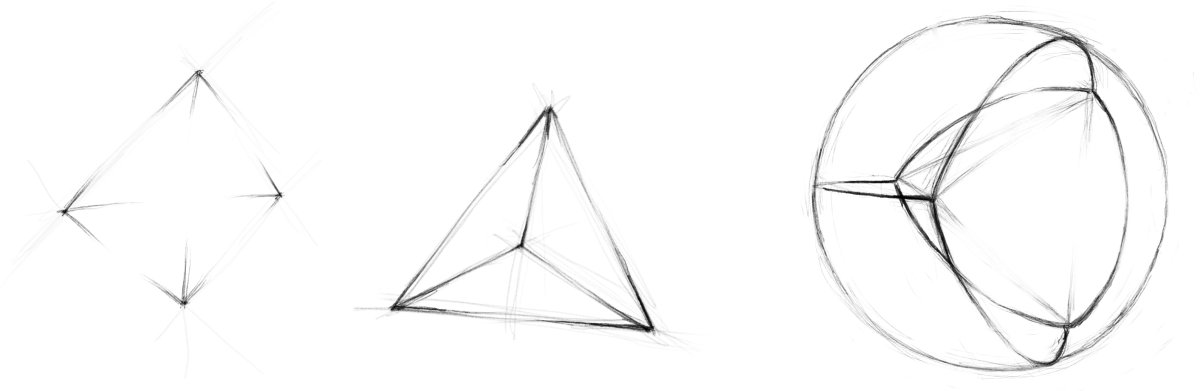
From this analysis emerges a first structural threshold. A detailed combinatorial study shows that no finite signed graph with fewer than four vertices can satisfy the four PDL axioms of binary pulsation, triangular coherence, minimal completeness, and logical optimisation. The first admissible stationary closure is the complete signed graph on four vertices and six edges — the (4,6) structure — which realises a coherent network of triangles together with a global 2-cycle on the edge signs. In PDL, this minimal closure is not postulated to be the electron; rather, the electron at rest is interpreted as the first physical realisation of this logically compelled stationary regime. The theorem precedes the particle.
Within the same framework, more elaborate composite structures motivate the appearance of specific ratios — such as the golden ratio in the architecture of the proton's active surface — where it optimises the partition between internal coherence and surface coupling. Here, the golden ratio is not invoked as a mystical symbol, but as a candidate optimisation factor within a concrete combinatorial model: tightly constrained, mathematically scrutinisable, and open to refutation.
The Compton Frequency: The Pulse of the Logos
Once a minimal closure is established, the structure does not merely exist — it pulsates. The (4,6) configuration supports an intrinsic logical 2-cycle, a stationary regime in which the internal pattern of agreement and disagreement is perpetually re-established at a fixed coherence cost. In this perspective, the Compton frequency of the electron is no longer an arbitrary experimental parameter, but the physical manifestation of this internal pulsation when the (4,6) closure is realised in our universe. The reduced Planck constant can then be re-interpreted as the minimal quantum of action associated with one complete cycle of coherence, so that the familiar relation E = ℏω expresses nothing more — and nothing less — than the cost of continuing to exist.
From this vantage point, what conventional physics calls mass or energy becomes a way of measuring the density of internal coherence cycles, rather than a substance carried by a pre-given background. Matter appears as a pattern of logical closure so coherent that it has acquired stability and inertia. Not a thing in space, but a rhythm that space will eventually have to accommodate.
The Single Thread: From the Infinitesimal to Complex Structures
This impulse is not confined to the subatomic domain. PDL proposes a single relational thread that runs from minimal closures to composite architectures, metrics, and effective fields — without presupposing a continuum spacetime, without borrowing a background. If the same logic of closure and leakage underlies protons, emergent metrics, and the large-scale structure of the cosmos, then a unified description becomes conceivable in which apparently disparate phenomena share a common combinatorial origin. The same four axioms that select the electron also select the constants, the dynamics, and the geometry.
The Subatomic World
At the microscopic level, the rigour of the primary (4,6) closure finds expression in the electron prototype and in the hierarchical architecture of the proton. Through an optimisation principle applied under explicit constraints, this simple building block self-organises into a composite structure characterised by a finite set of integers: valence occupancies 24 and 28, a valence content rval = 930, a relational sea with 10 087 links, and a total relational budget of 11 017. These numbers are not introduced as empirical fits; they define a minimally complex stationary architecture whose internal consistency can be scrutinised mathematically and confronted with physical constants.
From this integer architecture, the fine-structure constant, Newton's gravitational constant, and the proton-electron mass ratio can each be derived — not fitted, not adjusted, but derived — as measures of how internal coherence is distributed between bulk, surface, and leakage into the surrounding relational network. The Schrödinger, Dirac, Born, and Einstein equations follow from the same source. The Hubble tension dissolves into a density-dependent coupling that was implicit in the proton's structure all along.
Beyond Physics: An Open Horizon
The current PDL corpus focuses primarily on foundational physics: existence as pulsating closure, particle-like structures, constants, emergent metrics and fields, and the interface with the Theory of Objectivity. It does not yet provide a full-fledged theory of life, evolution, or consciousness; any extension in these directions must therefore be regarded as speculative and metaphorical, and the programme is honest about that boundary. Nevertheless, the picture of reality as a hierarchy of closures that negotiate coherence and leakage invites broader reflections on how complex systems — including biological and cognitive ones — might be understood as higher-order organisations of the same underlying logic.
One may tentatively view living systems as structures that internalise and regulate their own coherence budgets in order to resist dissipation — and conscious experience as a regime in which certain closures become capable of representing aspects of their own organisational state. These suggestions are not formal results of the PDL framework, but questions opened by its ontological stance. They are the horizon, not the destination.
An Invitation to Cross the Threshold
The documents collected here and on Zenodo are the rigorous traces of this original pulse: they aim to reconstruct the passage from nothingness to persistent structures with as little arbitrariness as possible. Their mathematical arguments may at first appear austere, but they can be read as scores encoding a discrete harmony between logical constraints and physical phenomena. We invite you to explore these texts — from the emergence of the (4,6) block and the combinatorial proton, through the derivation of the fundamental constants and the four equations of dynamics, to the large-scale resolution of the Hubble tension — not as cold abstractions, but as fragments of a candidate architecture in which reason and intuition can meet.
What follows is not a finished theory, but a living programme — a candidate blueprint for how a logically constrained universe might organise itself from within. If it withstands further mathematical and empirical scrutiny, it would suggest that the universe has meaning not because it mirrors our concepts, but because it realises a remarkably specific structure. One that we are only beginning to read.
The Listening
Causality in the Mirror of Free Will
"This work did not begin with an equation, but with an act of listening." It was born from a suspicion, a radical intuition: that our basic concepts — space, time, matter — may be weakened echoes of a more fundamental language that we have largely forgotten how to hear. Not because that language is hidden, but because we stopped asking the question it answers. To follow the thread of PDL, one must first learn to be silent: to suspend the certainties of conventional physics and dare a different question — what is the cost of existence when no background, no pre-existing stage, is taken for granted? What remains when everything borrowed is returned?
A Causality of Global Coherence
In classical physics, causality often appears as a prison: an inescapable chain of cause and effect in which every event suffers the yoke of the previous one, reflecting the image of a clockwork universe wound up at the beginning of time. Within the PDL perspective, this picture is not rejected but reframed. Causality is no longer a merely linear sequence imposed from outside; it is the manifestation of a global requirement of coherence on a network of relations. In a world where everything is relation, an event does not simply obey an external law — it realises a pattern of closure that either preserves or disrupts the coherence of the whole.
Constants such as the fine-structure constant cease to be mysterious numbers floating free of any explanation, and become candidates for structural signatures — measures of how coherence is distributed between bulk, surface, and leakage in minimally stable architectures. In this sense, causality can be re-imagined as the way the Logos — the underlying relational order — prevents the parts from contradicting the unity of the whole. Less like the external push of mechanical gears, more like the internal necessity of a musical phrase: each note constrained by all the others, yet the constraint itself is what makes the phrase sing.
The Emergence of Freedom
It is within this absolute rigour that the question of freedom acquires a new profile. If the universe were nothing but blind chance or featureless determinism, free will would appear as a mere illusion — a story we tell ourselves to bear the weight of necessity. But if the universe is a projection of relational logic capable of self-organisation and self-reference, then the human observer need not be treated as an accidental by-product, a ghost haunting a machine it did not build. In that speculative reading, the observer is a closure point — a place where certain relational patterns gain the capacity to represent and evaluate aspects of their own organisation.
Free will, in this view, is not a rupture of physical regularities but a high-level expression of them: the moment where the Logos, after deploying itself through matter, biological complexity, and neural organisation, acquires the capacity to reflect on its own constraints. Freedom becomes the flower growing on the stem of necessity — not despite the stem, but because of it. When we study the 11 017 relations of the proton, we do not simply catalogue the bars of a prison; we begin to learn an alphabet from which more complex forms of organisation — including deliberation, choice, and love — may ultimately arise.
From Logic to the Soul: A Tentative Unity
This act of listening suggests a provocative possibility rather than a finished doctrine: that life, consciousness, and what we call the soul might not be foreign add-ons grafted onto inert matter, but higher-level expressions of the same logic of closure and leakage that underpins the microphysical world. Every choice we make, every act of will, every moment of attention — these can be read as resonances of an underlying projective dynamic, without pretending that PDL already furnishes a complete formal account of psychology or spirituality. The programme is honest about what it has proved and what it has only opened.
We are not merely passive witnesses of the cosmos; we participate in the re-organisation of the relational field through our actions and decisions. The journey proposed here is the chronicle of a thought experiment pushed to its ontological horizon: the speculative recognition that our presence may not be a pure accident, but one possible way in which a logic of coherence tries to become aware of itself. The universe, on this reading, does not merely exist — it listens.
This act of listening does not require a prior command of mathematics or physics. Before the axioms and the graphs, before the derivations and the constants, there is a question — and that question can be followed in plain language. The book Whatever We May Be traces this path from beginning to end: from the stubborn existence of an electron to the fragility of the human condition, without presupposing anything beyond the willingness to think carefully. It is the threshold before the threshold — the place where the intuition of PDL can be met on its own terms, before the formal architecture takes over.
DN | Popular introduction to the PDL framework in book form, addressed to a dual audience from secondary school to research level. Traces the guiding thread from the minimal (4,6) closure and the combinatorial proton to coherence leakage, fundamental constants, and the human condition, without presupposing prior knowledge of the technical corpus. Primary accessible entry point to the programme.
D1 | The Emergence of Physical Reality within the Framework of the Projective Dynamic Logo (PDL). Core axioms, (4,6) block, proton architecture, constants, gravitation, cosmology.
The Threshold
The Archives of a Foundational Programme
"The maps of the Logos: when structure becomes destiny." If this resonance finds an echo within you, the true exploration begins where words fade and the rigour of structure takes over. The documents gathered here are not mere technical reports or isolated academic speculations; they are the formal tracings of a world explored from the absolute nakedness of logic. They constitute the archives of a foundational programme in which each construction is a boundary crossed, each proof a territory won back from the fog of assumption, and each constant a bridge — not postulated, but derived — toward a deeper unification.
The Unification of Scales: A Single Thread
In these pages, you will encounter an architectural framework that seeks to close the gap between the subatomic and the cosmological — not by adding new fields or particles, but by showing that the gap was never as wide as it appeared. PDL proposes a candidate relational substrate beneath familiar formalisms. Within this perspective, gravitation is no longer treated as a mysterious force acting at a distance, but as the metric-level expression of minimal coherence leakage from composite nucleonic structures into a surrounding relational network.
From the primary (4,6) closure to the combinatorial proton architecture and the emergent metric, each step illustrates how much can be reconstructed from a small set of axioms on finite signed graphs — without invoking ad hoc particles or unconstrained fine-tuning. Newton's gravitational constant is now a theorem, not a parameter. The Schrödinger, Dirac, Born, and Einstein equations have been derived, not assumed. The Hubble tension dissolves — not into a new free parameter, but into the density-dependence of a coupling that was always there, waiting to be read off the proton's integer architecture.
The Heat Behind the Crystal
Do not be intimidated by the surgical precision of the demonstrations. The apparent coldness of mathematics here is that of a crystal, not of a void. Every crystal began as a liquid — disordered, searching, alive with possibility. The rigour you will find in these documents is not a closing of doors but an opening: each proof that narrows the space of possibilities simultaneously illuminates what remains, and it is in that remaining space that the truly interesting questions live.
Behind each derivation — from the global mapping of the programme, through the structural bridge between α and G, to the Gleason uniqueness of Born's rule — beats the intuition of a living, coherent, and ultimately intelligible universe. These works are attempts to address a familiar paradox: how necessity, structure, and meaning can coexist in a single world. They suggest that strict logical constraints need not be the enemies of richness or life, but may instead provide the cradle within which complexity can unfold. From this vantage point, biological evolution and the awakening of consciousness can be contemplated as possible higher-order expressions of the same logic of closure and leakage — not as results already derived by PDL, but as horizons opened by its ontological stance.
Life, in this light, can be pictured as logic that has learned to preserve and reorganise itself. Memory as coherence that endures long enough to be shared. And thought — perhaps — as a closure that has become capable of reflecting on its own conditions of existence.
The Invitation
You are invited to cross this threshold at your own pace. Whether you are guided by philosophical curiosity, by the rigour of theoretical physics, or by a quieter search for meaning, you are not a stranger to the system you are studying. By engaging with these texts, you become one of the points at which relational structures are reflected upon, questioned, and possibly reshaped.
Here, the time for narrative gives way to the time for argument. Enter the PDL corpus and examine for yourself how far four axioms on finite signed graphs can go — from the electron's first pulse, through the architecture of the proton, to the large-scale structure of the universe, and back again to the fragile coherence of a human life.
Welcome home, if this way of thinking resonates with you.
A Guided Journey
Phase I — The Awakening (Logical Foundations)
How "nothing" becomes a persistent distinction.
- DN | Whatever We May Be — The Projective Dynamic Logo
Narrative entry point to the entire programme: a book-form introduction requiring no prior knowledge of the technical corpus. Traces the guiding thread from the question of persistence, through the minimal (4,6) closure and the combinatorial proton, to coherence leakage, fundamental constants, and the human condition. The recommended first reading for any newcomer to PDL. - DM | PDL: Global Mapping of Structures, Results, and Open Problems (version 15)
The authoritative meta-level guide to the current state of the programme: complete corpus table (D01–D42), logical dependency map from axioms to the Einstein equation, black hole thermodynamics, nuclear stability, and nuclear spectroscopy confrontation, fifteen prioritised open problems, eight falsifiable predictions, and a practical continuation guide for new collaborators. Version 15 incorporates D42 and marks the resolution of the programme's sole foundational open problem.
- D02 | Introduction to the Projective Dynamic Logo (PDL)
Conceptual entry point: motivation, "reality as logical closure", first encounter with the (4,6) block, the proton architecture, and key constant relations.
- D01 | The Emergence of Physical Reality within the Framework of the Projective Dynamic Logo (PDL)
Core founding text: axioms on signed graphs, definition of closures, emergence of the (4,6) block, proton architecture, reinterpretation of fundamental constants, and first steps towards gravitation and cosmology.
- D16a | Minimal Stationary Closures in the PDL Framework: Necessity of the (4,6) Block
For readers wanting the full proof: theorem establishing that no finite signed graph on three or fewer vertices satisfies all four PDL axioms, and that the (4,6) configuration on four vertices is the unique first admissible elementary stationary closure. - D19 | Existence as Pulsating Closure: An Ontological Meditation on the PDL Framework
Philosophically oriented reflection on what it means, in the PDL language, for something to exist as a self-sustaining pulsating closure. Clarifies the passage from logical nothingness to minimal closure, the rôle of boundaries and active surfaces, and how coherence leakage can be interpreted as a disciplined notion of transcendence. - D20 | Whoever We May Be: Existence, Coherence, and Vulnerable Instruments — A Philosophical Synthesis of the PDL Framework
Philosophical synthesis unfolding the guiding sentence "Whoever we may be…" in the light of minimal closures, proton architectures, coherence leakage, and emergent metrics, and clarifying how the programme bears on causality, freedom, transcendence, and human vulnerability.
Phase II — The Architecture of Matter (Atomic Blueprint)
How dense relational patterns stabilise matter.
- D16 | On the Combinatorial Selection of the Proton Architecture in PDL (v2)
Combinatorial and axiomatic analysis of the proton architecture: integer constraints, selection functional, rôle of the quintuplet (24, 28, 930, 10087, 11017), and discussion of competing candidate architectures.
- D16b | On the Combinatorial Selection and Local Uniqueness of the Proton Architecture in the PDL Framework
Focused study of local uniqueness: admissible proton configurations, definition of a selection score, and explicit local uniqueness conjecture around the PDL solution. - D22 | Nuclear Stability and the Periodic Table as Combinatorial Closure Hierarchies in the PDL Framework
First formal derivation of the neutron quintuplet from the proton architecture. The internal asymmetry Δn = n_d − n_u = 4 is shown to be the structural source of the nuclear spin-orbit coupling introduced phenomenologically by Goeppert-Mayer and Jensen in 1949. The maximum magic number N_crit,max = 126.1 is derived without free parameters. The periodic table emerges as a map of collective closures bounded by sea exhaustion.
- D40 | Nuclear Stability and the Periodic Table from PDL Combinatorial Axioms: Derivation of the Valley of Stability, Magic Numbers, and Assembly Rules
Derives the complete architecture of nuclear stability from the proton and neutron quintuplets alone, without additional parameters. Central results: N_min(Z) = Z for all Z ≤ 20 as an exact theorem of the neutron survival condition; the conflict saturation C(Z > 20) = 190·T_pp exactly; the valley of stability reproduced at 100% accuracy for all 51 elements from Z = 1 to Z = 82 via integer filling rates r_exc ∈ {0, 1, 2, 3} linked to the harmonic oscillator sub-shell structure with PDL spin–orbit splitting Δn/(2n_u) = 1/12; and eight explicit assembly rules governing sequential nuclear construction from hydrogen to iron. A structural connection is identified between the open problem of deriving the filling rates analytically (OP14) and the open problem of deriving the Bekenstein–Hawking coefficient 1/4 from axioms (OP12): both reduce to counting coherent configurations on a collective PDL surface.
- D41 | Structural Closure Multiplicity and the Isospin-Symmetric Island of Inversion: a PDL Analysis of ⁸⁴,⁸⁶Mo
First confrontation of the PDL nuclear framework with a published nuclear spectroscopy experiment (Ha et al., Nature Communications 16, 10631, 2025). Three independent observables from the published source data are consistent with the structural identity T ≈ (Δn+1)² = 25: the B(E2) transition ratio (22% discrepancy, within experimental uncertainty), the DNO-SM wave-function component ratio N_comp(⁸⁶Mo)/N_comp(⁸⁴Mo) = 1.962 vs. the PDL prediction 2.000 (2% discrepancy), and the Shannon entropy difference (25% discrepancy). Introduces the closure multiplicity conjecture H_B and two falsifiable predictions for ⁸⁸Ru/⁹⁰Ru and ⁹²Pd/⁹⁴Pd, testable at FRIB and RIKEN.
- D05 | A Minimal Relational Sketch for the Emergence of the Golden Ratio in PDL
Conceptual sketch showing how a self-similar core–surface partition inside the proton selects the golden ratio φ = (1+√5)/2 and constrains the effective active surface R_surf = φ·r_val/3.
- D10 | From Discrete Coherence Flux to Effective Fields: A Structured Programme within the PDL Framework
Development of discrete Gauss- and Faraday-like relations from mixed-triangle coherence fluxes, derivation of 1/r² Coulomb profiles, and first bridges towards effective field descriptions. - D10a | Proper Time as Coherence-Cycle Counting, Emergent Metric, and Relational Distance in the PDL Framework
Proper time is not a primitive in PDL: it is the count of coherence cycles experienced by a closure. This document establishes the emergent Minkowski structure from relational distances and provides the metric foundation underlying the dynamical results of Phase V. - D18 | Discrete Cavity Modes and Logical Density of States in the PDL Framework
Construction of a three-dimensional PDL cavity as a finite signed graph and analysis of photon-like logical excitations. Low-leakage periodic modes yield an effective density of states ρ(ν) ∝ ν² in three dimensions, recovering standard continuum cavity behaviour from purely relational dynamics.
Phase III — The Constants (Scales of Being)
Why the constants take the values they do.
- D12 | A Structural Derivation of the Fine-Structure Constant from the PDL (v2)
Closed-form expression for α in terms of the proton–electron mass ratio, r_val = 930, and the golden ratio, with relative accuracy ~10⁻⁴ and no free parameters.
- D06 | Hierarchical Filtering of Coherence Leakage and Justification of the Exponent 18 in PDL
Original formulation of the coherence leakage mechanism: 18 filters from proton-level defect to macroscopic gravitational coupling, with the first qualitative argument for the minimality of the exponent.
- D17 | Coherence Leakage, Hierarchical Filtering, and the Exponent 18 in the PDL Framework
Refined treatment: minimal closure defect ε on admissible proton graphs, organisation of the 18 filters into three hierarchical blocks, and effective coupling ansatz. Read after D06. - D23 | Topological Origin of the Exponent 18 in the PDL Gravitational Coupling: K₄, S² and the Periodic Table
Theorem: the exponent 18 in G_eff ∼ ε¹⁸ is a topological necessity, not a counting choice. K₄ is homeomorphic to S², and its homology imposes exactly the decomposition 18 = 6+5+4+3. The same invariant explains the maximum electron count per period in the periodic table: both are invariants of S² imposed by the three-dimensionality of space. - D21 | Universal Coherence Leakage: A Structural Bridge between G and α (Version 3)
Global synthesis of the leakage mechanism and the geometric bridge locking G and α to a single proton-level defect ε_G. Derives G_PDL = 6.67448 × 10⁻¹¹ m³ kg⁻¹ s⁻² at 27 ppm from CODATA 2022 without free parameters.
- D25 | A Parameter-Free Structural Bridge between the Fine-Structure Constant and Newton's Gravitational Constant
The definitive form of the α–G bridge: full parameter-free derivation with ε_G = 0.0075194, G at 27 ppm. The primary reference for the structural connection between the two fundamental constants in PDL. This document and D21 (V3) together constitute the quantitative core of the constants sector.
- D08 | Logical Leakage as Self-Maintained Probability: A Topological Reformulation in the PDL Framework
Topological reformulation: coexistence topology, coherence-cost pseudo-metric, and interpretation of leakage as intrinsic non-closure probability with links to gravitation, quantum probabilities, and thermodynamics.
Phase IV — The Three Gates (Critical Proofs)
How Newton's constant becomes a theorem.
- D28 | The PDL–QCD Boundary: Structural Derivation of the Proton–Electron Mass Ratio Correction
Identifies the PDL–QCD interface: the mass ratio correction δμ = (155/11017)·(1 − 2Δm_iso/m_p) and the ε_G conjecture. Sets up the three Gate proofs that follow.
- D29 | Axiomatic Derivation of 155/11017 — Gate 1 Resolved
Theorem: the amplitude 155/11017 is proved from PDL axioms C1–C4 alone via the (A)∧(B) coupling criterion, verified exhaustively over all 768 admissible configurations. No free parameter enters. This is the first Gate proof, establishing that the mass ratio correction is combinatorially necessitated by the axioms.
- D30 | Structural Derivation of the QCD Correction Coefficient — Gate 2 Resolved
Theorem: the coefficient a = 2 is structurally forced by axiom C1 (minimal binary pulsation). The isospin mass splitting Δm_iso = m_d − m_u is identified as the unique irreducible external parameter at the PDL–QCD interface; all other quantities are combinatorial. Gate 2 establishes that G = G(quintuplet, Δm_iso): a theorem with a single external input from QCD.
- D36 | Proof of G_eff(N) = σ(N)·G_PDL from the Trace Structure of K₄ — Gate 3 Resolved
Unconditional theorem (D42): the density-dependent gravitational coupling G_eff(N) = σ(N)·G_PDL is proved from the trace structure of K₄. The independence of gravitational engagements (δ = 0) and the tracelessness Tr(A) = 0 follow algebraically from (A)∧(B) without additional assumptions. The hypothesis H1 is proved under H3 in D39; H3 itself is proved from C1–C4 in D42. Gate 3 is now fully unconditional. The companion document D31 provides the preliminary version of this proof.
- D39 | Derivation of κ = R_surf/R_tot from the PDL Axioms: the Indifference Lemma
Partial resolution of Open Problem OP1 (D36), completed by D42. Establishes the two-factor decomposition κ = (φ/3)·(r_val/R_tot) = R_surf/R_tot under the named hypothesis H3 (the Indifference Lemma: the measure on the R_tot relations of a PDL closure is uniform). A negative result is also proved: axiom C3 alone does not imply the uniform measure. H3 is constrained to better than 0.01% by the Hubble tension observable. The derivation of H3 from C1–C4 — the programme's sole foundational open problem — is completed in D42.
Phase V — The Derived Equations (The Dynamics)
Schrödinger, Dirac, Born, and Einstein from four axioms.
- D32 | Schrödinger Dynamics from the (A)∧(B) Coupling Criterion in the PDL Framework
Theorem: the Schrödinger equation is derived — not postulated — from the (A)∧(B) coupling criterion applied to the K₄ pulsation dynamics. The diffusion parameter b = −iħΔt/(2m_e(Δx)²) is uniquely forced by the stability requirement; no free parameter enters.
- D33 | Dirac Equation from the SL(2,ℂ) Pulsation of K₄ in the PDL Framework
Theorem: among eight candidates for the time-reversal operator T, the unique admissible choice consistent with (A)∧(B) is T = −iτ₂. This forces T² = −I₂, implying period-4 dynamics and hence spin-½ statistics. The Clifford algebra of Dirac matrices follows as a theorem; the non-relativistic limit recovers the result of D32 exactly.
- D34 | Born Rule from (A)∧(B)-Admissible Amplitudes in the PDL Framework
Theorem (Level 1): the five Gleason axioms are verified for the PDL coherence-cycle measure. By the Gleason uniqueness theorem for spin-½, the probability assignment is uniquely P₊ = |⟨+θ|ψ⟩|². Born's rule is not postulated; it is the only probability rule compatible with the relational axioms.
- D35 | Quantitative Einstein Equation from G_eff(N) = σ(N)·G_PDL in the PDL Framework
Unconditional theorem (D42): κ_PDL(N) = σ(N)·κ_Newton, and the PDL Einstein field equation takes the form G_μν[g_eff] = κ_PDL(N)·C_coh. The Hubble tension ratio H₀,local/H₀,CMB is reproduced at 0.006% relative error with zero free parameters. Synthesis document for the gravitational and cosmological sectors.
Phase VI — Cosmology (The Large-Scale Structure)
From the proton architecture to the Hubble constant.
- D24 | Closure-Density Dependence of the Effective Gravitational Coupling and the Structural Origin of the Hubble Tension
Introduces σ(N) = 1−(1−κ)^N as the effective coherence engagement fraction for an ensemble of N nucleons. The density-dependent gravitational coupling G_eff(N) = σ(N)·G_PDL provides the structural origin of the discrepancy between local and CMB Hubble measurements.
- D27 | Structural Derivation of N_CMB from the PDL Neutron Architecture: A Parameter-Free Resolution of the Hubble Tension
Theorem: N_CMB = ⌊Γ_n⌋ = 40, where Γ_n = 6μ_n − R_tot(n) = 40.102 is derived from the neutron quintuplet without free parameters. The resulting H₀,CMB = 67.26 km/s/Mpc agrees with Planck 2018 to 0.27σ. Combined with D35, this resolves the Hubble tension at 0.006% with zero free parameters.
Phase VII — Black Hole Thermodynamics
Entropy lives on the surface because the interior has nothing left to say.
- D37 | Surface Locality of Relational Entropy and the PDL Area Law
Unconditional theorem (no hypothesis required beyond the four PDL axioms): the entropy of a PDL closure is carried entirely by its active surface R_surf. The valence sector contributes exactly zero entropy — its (A)∧(B)-stable configuration is unique, leaving no accessible microstate. The sea sector is excluded from stationary coupling by the same criterion. The Bekenstein–Hawking area law S ∝ A is therefore a structural consequence of the axioms, not an independent postulate of black hole physics.
- D38 | Bekenstein–Hawking Entropy from the PDL Effective Gravitational Coupling: the 4π Identity, Surface Counting, and Primordial Black Hole Predictions
Unconditional theorem (D42): substituting G_eff(N) = σ(N)·G_PDL into the Bekenstein–Hawking formula yields the exact algebraic identity S_BH/k_B = 4π(M_eff/M_Pl)², with M_eff(N) = σ(N)·N·m_p, verified to relative error <10⁻¹⁵ over ten decades of black hole mass. Three parameter-free falsifiable predictions follow: (i) a 15% suppression of black hole entropy per unit mass at the CMB epoch; (ii) an 11.9% upward shift of the primordial black hole survival threshold, testable via Fermi-LAT gamma-ray constraints; (iii) a redshift-dependent entropy-to-energy ratio S_BH/E ∝ σ(N(z)) traceable in AGN populations.
Phase VIII — Dialogue and Open Frontiers
Where PDL meets other frameworks and the next questions begin.
- D09 | PDL as a Foundational Research Programme: Current Status, Open Problems, and Interface with the Theory of Objectivity
Position paper: systematic survey of the programme's epistemic stratification and open questions. Written before Sessions 11–15; the open problems it lists have since been substantially addressed. Valuable for historical perspective and for understanding the interface with the Theory of Objectivity.
- D04 | A Modal Dialogue between the Projective Dynamic Logo (PDL) and the Theory of Objectivity (TO)
Modal dialogue between PDL and TO: comparison of axioms with TO's Seven Absolute Truths, analysis of ontological commitments, boundary conditions, and multi-observer perspectives.
Phase IX — The Closure of Causality
Nothing survives outside a closure — and the chain from axioms to physics is now complete.
- D42 | Derivation of H3 from Axioms C1–C4: The Equiparticipation Lemma and the Closure of Causality
Resolves the programme's sole foundational open problem (OP1, D39). Three lemmas are established from first principles: the Equiparticipation Lemma (D42-L1, proved algebraically and verified exhaustively for n = 4–7), the Cross-Triangle Blindness Lemma (D42-L2, from D39), and the S₄-Equivariance Lemma (D42-L3, verified over 24,576 cases with zero violations). Together they prove that the uniform measure on R_tot is the unique measure consistent with axioms C1–C4 — without invoking D36 as external input. As a corollary, κ = 310φ/11017 ∈ ℚ(√5) is promoted to an unconditional theorem of C1–C4, and the entire derivation chain from axioms to the Bekenstein–Hawking entropy formula is closed without any residual hypothesis. A second corollary exhibits the multi-scale universality of the principle: any internal asymmetry without structural foundation is eliminated by C4-optimisation, at every scale from signed graphs to Darwinian evolution.
ID |
Title |
Focus |
|---|---|---|
D01 |
Core founding article: four relational axioms on signed graphs, minimal (4,6) block, proton architecture, reinterpretation of fundamental constants, first steps towards gravitation and cosmology. |
|
D02 |
High-level conceptual overview, summary of main structures, proton integers, and key constant relations. Recommended first technical reading for any newcomer to PDL. |
|
D03 |
Journal-formatted (IMRad) version of D01. Presents the core PDL results in a structure adapted for submission to scientific journals. |
|
D04 |
Comparative analysis of PDL and TO: modal and ontological commitments, multi-observer and boundary issues, transcendent substrate, and dialogue between the two frameworks' axiom systems. |
|
D05 |
Conceptual derivation of the golden ratio from the proton core–surface partition; constraints on the effective active surface R_surf = φ·r_val/3 associated with electromagnetic coupling. |
|
D06 |
Original formulation of the coherence leakage mechanism and first argument for the exponent 18 as the total number of hierarchical filters from proton-level defect to macroscopic gravitational coupling. |
|
D07 |
Early sketch of the Gleason approach to Born's rule in the PDL context. Historical document: superseded at Level 1 by the full proof in D34. |
|
D08 |
Coexistence topology and coherence-cost pseudo-metric; interpretation of leakage as intrinsic non-closure probability; links to gravitation, quantum probabilities, and thermodynamics. |
|
D09 |
Position paper: first systematic epistemic stratification of the programme, robust vs conjectural results, open-problem list, and interface with the Theory of Objectivity. Written before Sessions 11–15; the open problems it lists have since been substantially addressed. |
|
D10 |
Discrete Gauss- and Faraday-like relations from mixed-triangle coherence fluxes; derivation of 1/r² Coulomb profiles; first bridges towards effective field descriptions and Schrödinger-type dynamics. |
|
D10a |
Establishes proper time as a count of coherence cycles rather than a primitive. Derives the emergent Minkowski structure from relational distances between closures; metric foundation for the dynamical results of D32–D35. |
|
D11 |
Preliminary sketch coupling Dirac spinors to the emergent coherence-cost metric; consistency tests via hydrogenic limits and gravitational redshift. Historical document: superseded by the full derivations in D33 (Dirac) and D35 (Einstein). |
|
D12 |
Closed-form expression for α in terms of the proton–electron mass ratio, r_val = 930, and the golden ratio; relative accuracy ~10⁻⁴ with no free parameters. |
|
D13 |
Implementation of PDL-derived α and proton structure into the hydrogenic Schrödinger equation; spectral concordance checks. Historical document: superseded at the level of derivation by D32. |
|
D14 |
Relational derivation of Born's rule for spin-½ from finite active surfaces; refined rôle of the golden-ratio proton surface and its connection to α. Historical document: superseded at Level 1 by D34. |
|
D15 |
Relational sketch of Schrödinger emergence from coherence cycles and flux balance. Historical document: superseded by the full derivation in D32. |
|
D16 |
Combinatorial and axiomatic analysis of the proton architecture: integer constraints, selection functional, rôle of the quintuplet (24, 28, 930, 10087, 11017), and discussion of competing candidate architectures. |
|
D16a |
Theorem: detailed axiomatisation on finite signed graphs; proof that no closure exists on three or fewer vertices and that the (4,6) block on four vertices is the unique first admissible elementary stationary closure. |
|
D16b |
Refined admissibility conditions for proton architectures; selection functional S; local uniqueness conjecture for the quintuplet (24, 28, 930, 10087, 11017). |
|
D17 |
Refined treatment of coherence leakage ε on proton graphs; organisation of the 18 filters into three hierarchical blocks; effective coupling ansatz for the emergent gravitational constant. |
|
D18 |
Construction of a three-dimensional PDL cavity as a finite signed graph; low-leakage periodic modes; derivation of an effective density-of-states scaling ρ(ν) ∝ ν² mirroring standard continuum cavity behaviour. |
|
D19 |
Philosophical reflection on existence as self-sustaining pulsating closure; passage from logical nothingness to minimal closure; boundaries, active surfaces, coherence leakage, and disciplined transcendence in direct dialogue with the technical corpus. |
|
D20 |
Philosophical and ontological synthesis of the PDL framework. Connects minimal closures, proton architectures, coherence leakage, and emergent metrics to causality, freedom, transcendence, and human vulnerability. Accessible entry point without new technical results. |
|
D21 |
Establishes the geometric bridge locking G and α to a single proton-level defect ε_G. Derives G_PDL = 6.67448 × 10⁻¹¹ m³ kg⁻¹ s⁻² at 27 ppm from CODATA 2022 without free parameters. |
|
DN |
Popular introduction to the PDL framework in book form, addressed to a dual audience from secondary school to research level. Traces the guiding thread from the minimal (4,6) closure to coherence leakage, fundamental constants, and the human condition. Primary accessible entry point to the programme. |
|
D22 |
First derivation of the neutron quintuplet from the proton integers; maximum magic number N = 126 and saturation threshold Z ≈ 20 derived without free parameters; structural origin of nuclear spin-orbit coupling identified in Δn = 4; the periodic table as a map of collective closures bounded by sea exhaustion. |
|
DM |
Authoritative meta-level guide to the current state of the programme: complete corpus table D01–D42, logical dependency map from axioms to the Einstein equation, black hole thermodynamics, nuclear stability, and nuclear spectroscopy confrontation, fifteen prioritised open problems, eight parameter-free falsifiable predictions, and a practical continuation guide for new collaborators. Version 15 incorporates D42 and marks the resolution of the programme's sole foundational open problem (OP1). |
|
D23 |
Theorem: the exponent 18 in Geff ∼ ε18 is a topological necessity. K₄ is homeomorphic to S², and its homology imposes exactly the decomposition 18 = 6+5+4+3. The same S² invariant explains the maximum electron count per period in the periodic table: both are consequences of the three-dimensionality of space. |
|
D24 |
Introduces σ(N) = 1−(1−κ)^N as the coherence engagement fraction for an ensemble of N nucleons, giving G_eff(N) = σ(N)·G_PDL. Identifies the structural origin of the discrepancy between local and CMB Hubble measurements. |
|
D25 |
Definitive parameter-free form of the α–G bridge: ε_G = 0.0075194, G_PDL at 27 ppm from CODATA 2022. Primary reference for the structural connection between the two fundamental constants in PDL. |
|
D26 |
G_PDL reinterpreted as a topology-dependent parameter; the Hubble tension identified as a scale-transition signature of the density-dependent coupling G_eff(N). |
|
D27 |
Theorem: N_CMB = 40 derived from the neutron quintuplet via Γ_n = 40.102, without free parameters. Yields H₀,CMB = 67.26 km/s/Mpc (0.27σ from Planck 2018). Combined with D35, resolves the Hubble tension at 0.006%. |
|
D28 |
Identifies the PDL–QCD interface: mass ratio correction δμ = (155/11017)·(1−2Δm_iso/m_p) and the ε_G conjecture. Sets up the three Gate proofs resolved in D29, D30, and D36. |
|
D29 |
Theorem: the amplitude 155/11017 proved from axioms C1–C4 alone via the (A)∧(B) coupling criterion, verified exhaustively over all 768 admissible configurations. No free parameter enters. |
|
D30 |
Theorem: the coefficient a = 2 is structurally forced by axiom C1. Δm_iso = m_d − m_u is identified as the unique irreducible external parameter at the PDL–QCD interface. G is now a theorem of the form G = G(quintuplet, Δm_iso). |
|
D31 |
First proof of Gate 3 under the linear bridge inversion hypothesis. Preliminary version, superseded in rigour by D36 which reduces the hypothesis to the single named condition H1, itself proved under H3 in D39. |
|
D32 |
Theorem: the Schrödinger equation derived from the (A)∧(B) coupling criterion applied to K₄ pulsation dynamics. The diffusion parameter b is uniquely forced by the stability requirement; no free parameter enters. |
|
D33 |
Theorem: among eight candidates for the time-reversal operator T, the unique admissible choice is T = −iτ₂, forcing T² = −I₂, period-4 dynamics, and spin-½ statistics. The Clifford algebra follows as a theorem; the non-relativistic limit recovers D32 exactly. |
|
D34 |
Theorem (Level 1): five Gleason axioms verified for the PDL coherence-cycle measure. By the Gleason uniqueness theorem for spin-½, Born's rule P₊ = |⟨+θ|ψ⟩|² is the unique probability assignment compatible with the relational axioms. |
|
D35 |
Theorem (under H3): κ_PDL(N) = σ(N)·κ_Newton; PDL Einstein field equation G_μν[g_eff] = κ_PDL(N)·C_coh. Hubble tension reproduced at 0.006% with zero free parameters. Synthesis document for the gravitational and cosmological sectors. |
|
D36 |
Unconditional theorem (D42): independence δ = 0 and tracelessness Tr(A) = 0 proved algebraically from (A)∧(B). Gate 3 is now fully unconditional: the hypothesis H1 is proved under H3 in D39; H3 itself is proved from C1–C4 in D42. The preliminary version is D31. |
|
D37 |
Unconditional theorem: the entropy of a PDL closure is carried entirely by its active surface R_surf, not by its total relational budget R_tot. The valence sector contributes zero entropy (unique (A)∧(B)-stable state); the sea sector is excluded from stationary coupling. The Bekenstein–Hawking area law S ∝ A is thereby a structural consequence of the four PDL axioms, not an independent postulate. |
|
D38 |
Unconditional theorem (D42): substituting G_eff(N) = σ(N)·G_PDL into the Bekenstein–Hawking formula yields S_BH/k_B = 4π(M_eff/M_Pl)², verified to relative error <10⁻¹⁵ over ten decades of mass. Three parameter-free falsifiable predictions: (i) 15% suppression of black hole entropy per unit mass at the CMB epoch; (ii) 11.9% upward shift of the primordial black hole survival threshold, testable via Fermi-LAT; (iii) redshift-dependent S/E ratio in AGN populations. |
|
D39 |
Partial resolution of Open Problem OP1, completed by D42. Establishes the two-factor decomposition κ = (φ/3)·(r_val/R_tot) = R_surf/R_tot under the named hypothesis H3 (the Indifference Lemma: the measure on R_tot is uniform, as the unique measure compatible with the S₄-symmetry of K₄). Proves that C3 alone does not imply the uniform measure. H3 is constrained to better than 0.01% by the Hubble tension. The derivation of H3 from C1–C4 is completed in D42. |
|
D40 |
Theorems: N_min(Z) = Z for all Z ≤ 20 as an exact consequence of the neutron survival condition; conflict saturation C(Z > 20) = 190·T_pp exact; valley of stability reproduced at 100% accuracy for all 51 elements from Z = 1 to Z = 82 via integer filling rates r_exc ∈ {0, 1, 2, 3} linked to the harmonic oscillator sub-shell structure with PDL spin–orbit splitting Δn/(2n_u) = 1/12; eight explicit assembly rules governing sequential nuclear construction from hydrogen to iron. A structural connection is identified between OP14 (analytic derivation of the filling rates) and OP12 (derivation of the Bekenstein–Hawking coefficient 1/4): both reduce to counting coherent configurations on a collective PDL surface. |
|
D41 |
First PDL confrontation with published nuclear spectroscopy data (Ha et al., Nature Communications 16, 10631, 2025). Three independent observables from the source data (MOESM3) are consistent with the structural identity T ≈ (Δn+1)² = 25: B(E2) ratio (22%), wave-function component ratio N_comp(⁸⁶Mo) / N_comp(⁸⁴Mo) = 1.962 vs. PDL prediction 2.000 (2%), and Shannon entropy difference (25%). Closure multiplicity conjecture H_B introduced. Two falsifiable predictions for ⁸⁸Ru/⁹⁰Ru and ⁹²Pd/⁹⁴Pd, testable at FRIB and RIKEN. |
|
D42 |
Resolves Open Problem OP1 (D39). Three lemmas proved: Equiparticipation (D42-L1 — on any C4-optimal complete signed graph, every edge participates in exactly n−2 coherent triangles, verified exhaustively for n = 4–7), Cross-Triangle Blindness (D42-L2, from D39), and S₄-Equivariance of cross-edge coherence (D42-L3 — 24,576 cases, zero violations, algebraic proof via stability of unordered pairs under bijections). Together: the uniform measure on R_tot is the unique measure consistent with C1–C4, without invoking D36. Corollary: κ = 310φ/11017 ∈ ℚ(√5) is an unconditional theorem. The entire derivation chain from axioms to the Bekenstein–Hawking entropy is now fully axiomatic. |
The Crossing
Entering the PDL Archive
If you have not yet read Whatever We May Be, it remains available as a companion at any stage of this journey — a way back into plain language whenever the formal structure calls for it. There is no shame in returning to the threshold; sometimes the clearest path forward runs through the words that first made the question feel necessary.
Beyond narrative and intuition, a different kind of journey begins — one traced in axioms, finite graphs, and carefully established proofs. The PDL corpus gathered here forms the working archive of a foundational research programme: from the minimal (4,6) closure and the combinatorial proton, through the structural derivation of the fundamental constants, to the Schrödinger, Dirac, Born, and Einstein equations derived from four axioms alone. Newton's gravitational constant is now a theorem. The Hubble tension is now a structural consequence. And the deepest open question remains, luminous and precise, at the frontier: whether the axioms themselves are enough to establish that a closure, in the absence of any external distinction, must treat all its own relations with perfect symmetry. Not a question about numbers or constants, but about whether indifference — the impossibility of preference without a reason — is itself a logical necessity. If it is, the last borrowed assumption dissolves, and the structure stands entirely on its own.
You are invited to explore these documents at your own pace and from your own background — not as spectators of a finished theory, but as participants in an ongoing attempt to understand how far a simple logic of closure and coherence can illuminate the world. The programme is open. The next proof has not yet been written.